
Bringing Visibility to Vincibility
In her documentary film, “Vincible” Kayla Redig reveals the unique trials faced by young adult cancer patients and survivors
By Valerie Hardy
When Kayla Redig noticed a lump in her breast and went to have it examined, the doctor told her it was probably just a cyst. Redig, a 2006 Downers Grove North High School graduate, was only 24 at the time and was otherwise healthy.
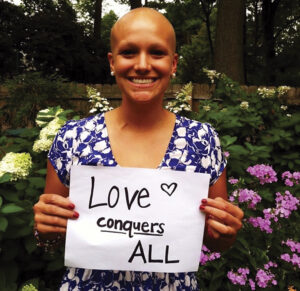
Despite her cancer diagnosis, Kayla Redig tried to remain positive.
The lump concerned her though, and despite her doctor’s reluctance to order an ultrasound or mammogram given the statistical unlikelihood of breast cancer at her age, Redig, a self-proclaimed “yes man and people pleaser,” was uncharacteristically adamant in her self-advocacy. “There was something inside of me pushing for an answer,” she said.
The answer she received was an unwelcomed one. She was diagnosed with breast cancer that had spread to the lymph nodes in her armpit. She went from feeling invincible to fearing for her life.
“Cancer at the age I was diagnosed tends to be more aggressive,” Redig said, so there was a sense of urgency around starting treatment. However, she was informed that if she wanted to have children, fertility treatment would be necessary before she could begin cancer treatment.
“Cancer didn’t just touch my left breast or armpit. It touched relationships, finances, career – you name it.”
– Kayla Redig, “Vincible” Director & Creator
Redig, who was unmarried at the time, said she did not feel it prudent to “risk my life and delay treatment for a family I didn’t even have.”
She decided to forego fertility treatment and commenced chemotherapy. She was buoyed by the support of family and friends, but she noticed that while her “friends were eager to show up to treatments…come Friday night, [her] phone would be really quiet.”
While Redig was fighting the debilitating side effects of chemotherapy, her friends were “out at the bar” and doing other “age-appropriate” activities that she could not do, even if she was invited, due to her compromised immune system. She felt distanced from her peers and unprepared for how her treatment would impact her, “not only physically, but also emotionally and psychologically,” she said.
Redig began thinking cancer treatment “wasn’t worth it.” Her mother, concerned about her declining mental health, told her doctors, “You’re doing a great job treating her body, but what about treating her mind?”
After starting an antidepressant regimen, Redig’s mood improved. “I changed how I wanted to show up to treatments,” she said, and she declared her chemo days as “Theme-o” days, including superhero, prom, mustache bash, Blackhawks, and the 1980s.
Redig dressed up accordingly, and so did members of her support system and medical care team. “For the 80s-themed day, my dad, who never missed a treatment, wore the 1980 ‘Miracle on Ice’ jersey and a hockey helmet, and my social worker came in her prom dress – actually from the 80s – clothespinned shut,” Redig said. Other patients started to dress in themed apparel too.
Redig finished treatment and received the “best possible outcome – no evidence of disease,” she said, but survivorship proved unexpectedly difficult. “Cancer didn’t just touch my left breast or armpit. It touched relationships, finances, career – you name it.”
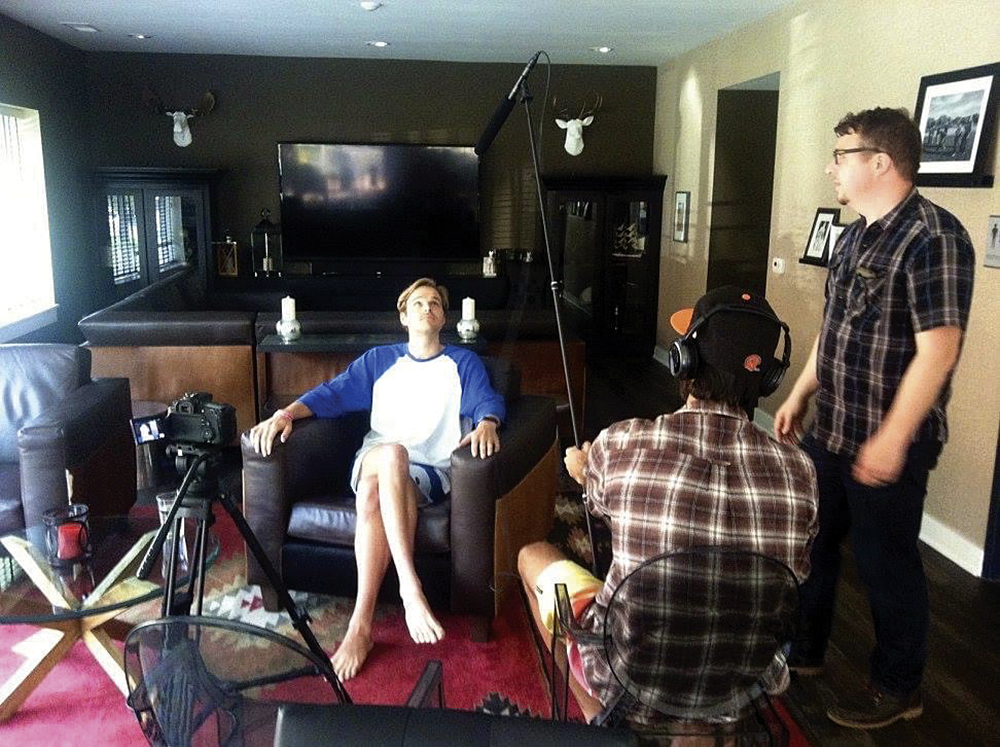
“VINCIBLE” CREW MEMBERS PREPARE FOR AN
INTERVIEW WITH ONE OF THE FILM’S SUBJECTS.
Having followed in her parents’ footsteps and become a teacher, Redig was overwhelmed upon returning to work post-treatment. “I sat in the car for two hours crying before I could go in to start my first day back teaching,” she said. “My world had changed so much.”
Teaching no longer resonated with her as it had pre-cancer, so she changed careers. “I started working for a company that actually let my title be Professional Cancer Survivor,” Redig said. In this role, she wrote professionally, leading her to contemplate writing a book, inspired by her cancer journey, “for the fighter, the friend, and the family member.”
However, a friend encouraged her to create a film instead. “I knew nothing about the film industry,” Redig explained, “but I am good at having an eye for good people and people who know their crafts.”
She set out to learn as much as possible and build a team to help her create what would become the documentary “Vincible,” which sheds light on the isolating experience of having cancer as a young adult. Redig said that after her diagnosis, she felt she “didn’t belong with peers but also didn’t belong in the hospital.”
She was surrounded by “childhood cancer and geriatric patients” during chemotherapy. “I didn’t see many people like me,” she lamented. “[Yet] my story is one of 70,000 per year just like it.”
Redig turned to social media to connect with other young adult cancer patients and survivors, “who were eager to share their stories and help create age-appropriate resources.”
During the filming process, the “Vincible” crew traveled to interview numerous young adult cancer patients and survivors, and “many beautiful friendships were created,” Redig said.
It took approximately two years, along with $45,000 from a Kickstarter campaign, to complete the film, which premiered in 2018. “Vincible” is available for streaming on Prime Video.
Some medical schools even include “Vincible” in their curriculums. “We love connecting with medical students as part of our continued advocacy work,” Redig said.
Redig’s recent advocacy work involves helping design a local hospital’s cancer center from a patient perspective, and she said she also works on the “professional side of the mental health world.”
Though busy with the demands of her professional commitments, Redig prioritizes time with her family, including her daughter, who was born in 2016, three years after her cancer diagnosis. Redig said doctors told her she was infertile “exactly one year to the day” before she learned she was pregnant. “The fact that I got a happy ending out of this was really remarkable.”
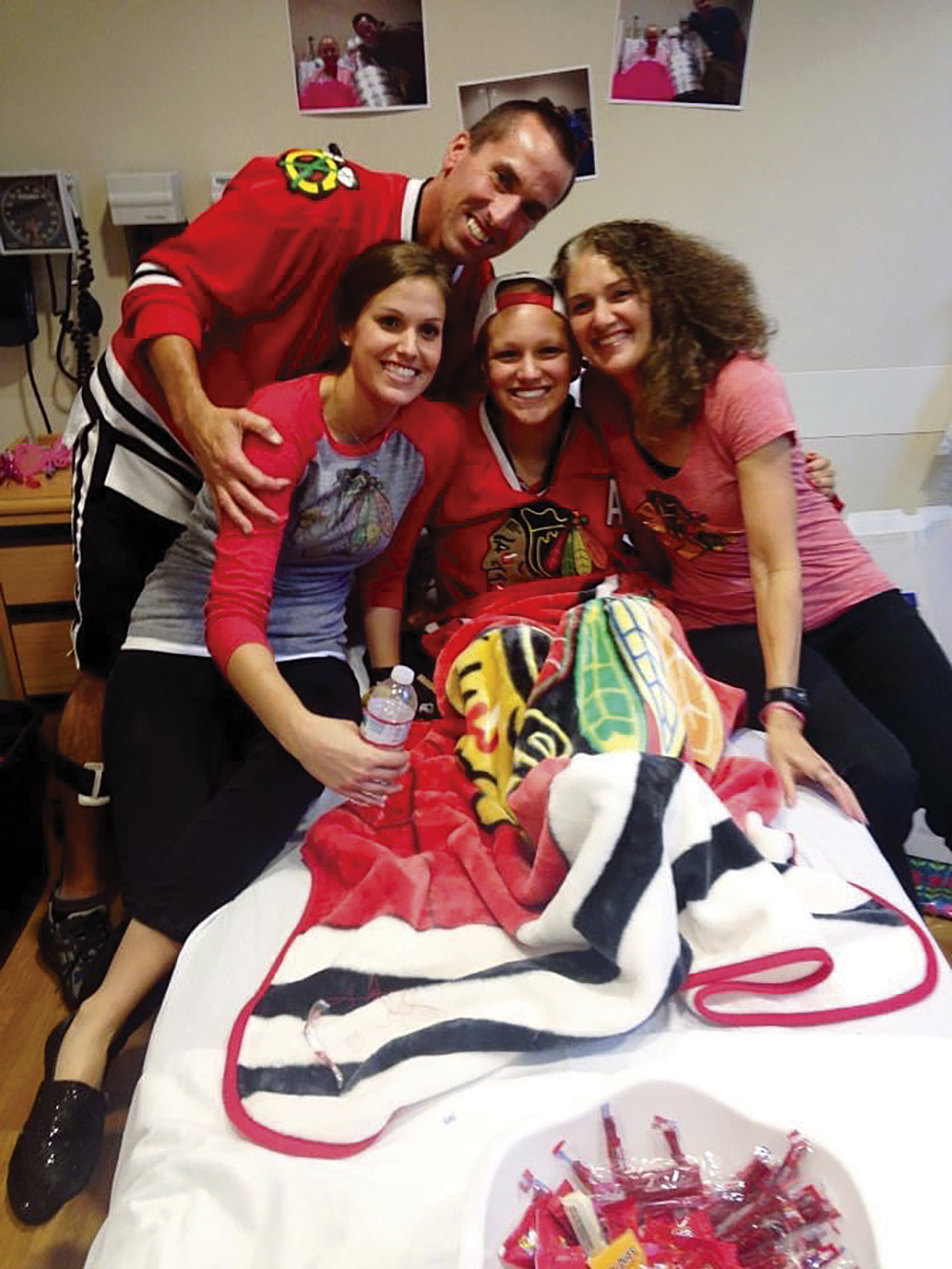
The Redig family chose “Blackhawks” for Kayla’s
last day of “Theme-o” to
honor her favorite team
for their support throughout her cancer experience.