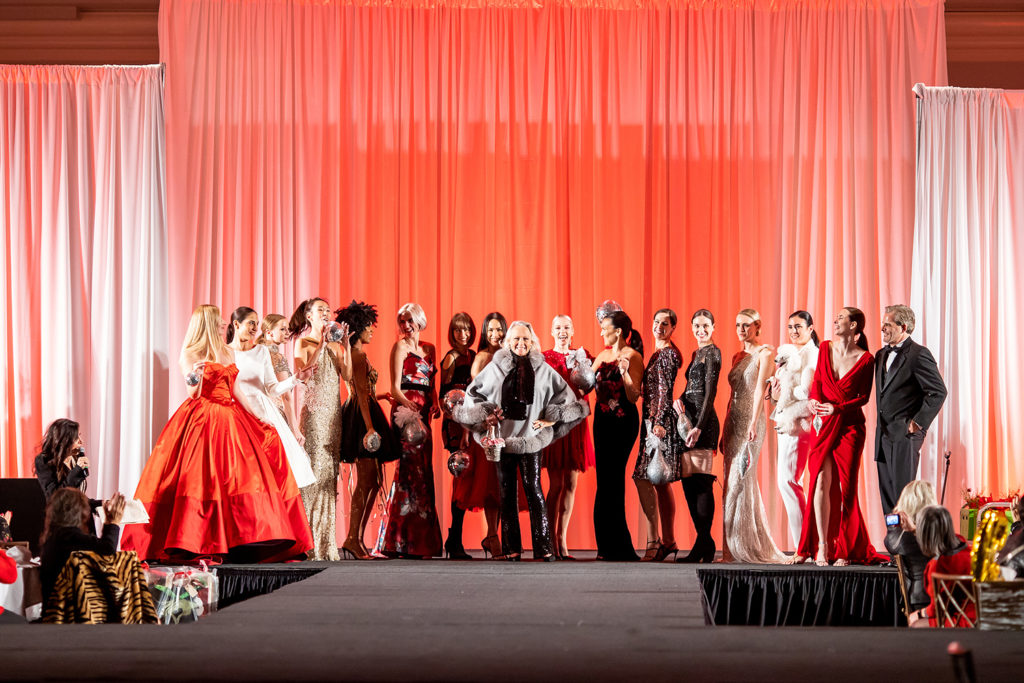

Elmhurst Art Museum’s Robert McCormick House
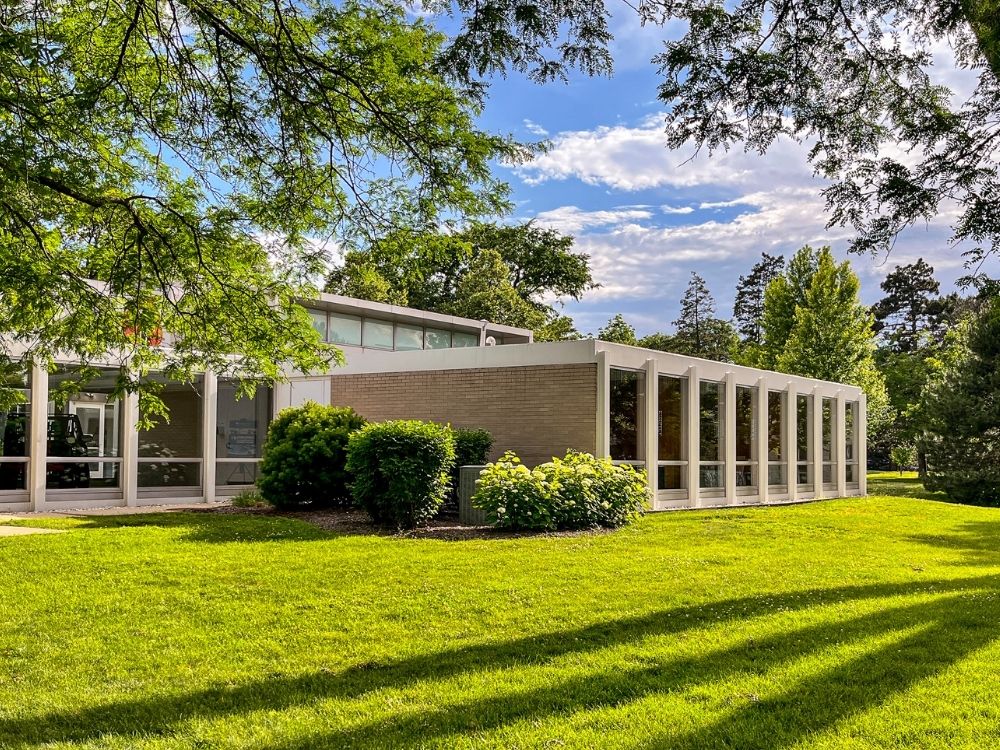
Mies van der Rohe’s eternal Modernism
Have you ever wondered about the house adjacent to the Elmhurst Art Museum? It used to be a private residence here in town and is one of only three in the United States designed by German immigrant Ludwig Mies van der Rohe. Mies van der Rohe is not only the home’s architect, but he is also considered one of the fathers of its distinctly industrial style, known as Modernism.
The house’s design was commissioned by real estate developer Robert Hall McCormick III and his wife, Isabella Stewart Gardner, in 1951. McCormick had met Mies van der Rohe through a construction project he was co-launching- twin steel and glass apartment buildings at 860-880 Lake Shore Drive. Mies van der Rohe’s rising reputation around the city led McCormick and his business partner to hire the architect after being turned down by several others, such as Frank Lloyd Wright.
The “Mies Towers” still stand at the edge of an internationally respected architectural cityscape. They are considered an epitome of his industrial, avant-garde style. Eventually, Mies van der Rohe & Associates came to be respected as one of the country’s most influential architectural firms.

The architect with prefabricated models in the Chicago Tribune
Courtesy of Elmhurst Art Museum Archives
McCormick and his wife, Isabella, lived in the house at its original 299 S. Prospect Avenue location for seven years. After their divorce, the house was rented to Arthur and Marilyn Sladek, where they raised their six children for a couple of years. In 1963, former Elmhurst mayor Ray Fick and his wife, Mary Ann, bought the house and lived in it until it was acquired by the Elmhurst Fine Arts and Civic Center Foundation in the early 90s.
In 1994, it was moved by flatbed truck to its current site, where a contemporary art complex (the home and Elmhurst Art Museum building) was incorporated. Today, a concrete plaza and walkway connect the museum building to the McCormick House.
Mies van der Rohe was a student and later, the last director, of the well-respected Bauhaus School of architecture, design and applied arts in Germany. Time spent at the institution influenced his modernistic style. The ‘less-is-more’ philosophy (a term which was popularized by Mies van der Rohe himself) is reflective of the architect who made his name on the design’s minimalism. Often described as “skin and bones,” importance is placed on the visibility of structural elements.
Mies van der Rohe’s austere style was first introduced as part of the German Pavilion (a home) at the 1929 Barcelona World’s Fair. The fair put his work on the proverbial map as photos of the prototype home circulated around the continent. The fair also afforded an opportunity to showcase his furniture designs, such as his internationally famous Barcelona Chair.
Mies van der Rohe fled Hitler’s rise to power in the late 30s. He came to Chicago to head up Illinois Institute of Technology’s (then known as The Armour Institute) architectural program. He also designed many of the buildings on the university’s new campus
Over the next three decades, Mies van der Rohe’s name came to be significant through the modern designs of the three buildings that comprise Chicago’s Federal Center – the Kluczynski Federal Building, the Dirksen Federal Building and the Post Office Loop Station. The designs of these three buildings reflect the emphasis on functionality and simplicity synonymous with the architect’s name.
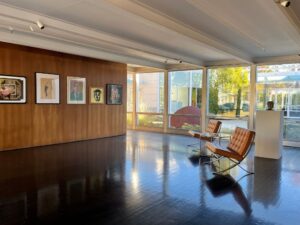
The architect’s Barcelona chairs in the McCormick House exhibit
Photo courtesy of Elmhurst Art Museum Archives
The McCormick House is a fine example of these philosophies. Concepts of free-flowing space and minimal interior wall partitions, as well as his desire to connect indoor and outdoor spaces, became Mies van der Rohe’s calling card.
The house consists of two wings – one intended for the parents and the other for the children. Glass exterior walls and steel partitions, as opposed to mortar walls and conventional windows, were hallmarks of Mies van der Rohe’s designs. Both wings lack traditional interior walls between rooms. Mechanical services, bathrooms, a galley kitchen and heaters were arranged compactly into a central core surrounded by movable wooden panels.
The McCormick House -actually built as a prefabricated home prototype- represented Mies van der Rohe’s attempt to join the housing shortage discussion of the decade following the end of World War II. In that moment, his renderings, based on an increasingly urbanizing America, made sense. While his designs became part of the larger conversation, his prefabrication plans never came to fruition.
Like his style or not, Mies van der Rohe earned a place of profound respect in the city’s skyline. His name is synonymous with Chicago architecture. Today, only three private “Mies homes” are found in the U.S. – The McCormick House, The Farnsworth House, in Plano, IL and The Morris Greenwald House in Weston, CT. We are fortunate to have such a concrete example of Modernism as part of The Elmhurst Art Museum’s permanent collection.
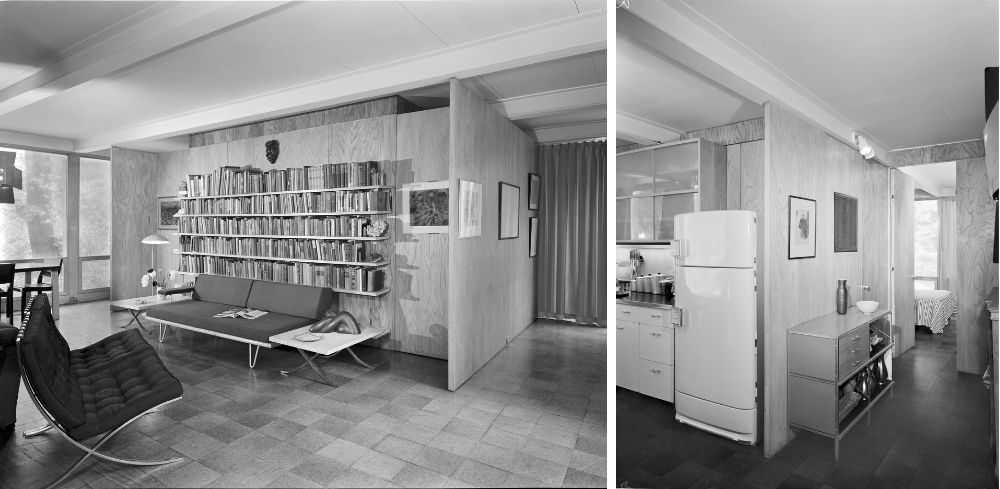
Modernism dictates open spaces with few permanent walls.
Photo by Hedrich Blessing, Courtesy of Elmhurst Art Museum Archives