
Jens Jensen
The internationally recognized landscape artist left his mark on the American Midwest
If you live in the Chicagoland area, you’ve probably seen the genius of visionary landscape architect Jens Jensen. His designs of outdoor spaces are nothing less than masterpieces. Born to a prosperous family near Dybbǿl, Denmark, in 1860, he grew up on his family’s farm. From an early age, he related well to the natural world.
Jensen attended the Tune Agricultural School outside of Copenhagen. After serving in the military, he emigrated to the United States with his fiancée in 1884. He first took up farming in Florida, followed by Iowa. But landscapes were always on his mind. To Jensen, time spent in nature was a necessity for the human soul.
At the time Jensen arrived in Chicago in the mid-1880s, it was the fastest-growing city in human history. While he had fallen in love with the native prairie of the American Midwest in all seasons, he witnessed, firsthand, its destruction and loss in the explosive industrial growth. Preserving the prairie – and emulating its beauty – became his life’s ambition.

Jensen felt at home in the disorder of a natural setting.
Instead of trying to create designs that opposed natural settings, Jensen sought harmony with nature in the already existent surroundings. For him, the canvas was a living entity.
Jensen is one of the authors of the Prairie Style landscape movement, which favored natural materials in natural forms. Using nature as his medium, he paralleled the buildings of Frank Lloyd Wright and Louis Sullivan by designing their accompanying outdoor space.
As one takes in a Jensen project, his design philosophy comes to life. Shadow and light were significant to him. He preferred natural curves on meandering paths and a sense of drifting rather than a structured route. Jensen saw his work as not only artistic but also spiritual.
At first, Jensen sought a position within the Chicago park system as a designer. When he was instead offered a job as a laborer in Union Park on the city’s west side, he took it. Within a year, he was made foreman of the park.
On weekends during those first years in the Midwest, his family traveled by rail to the countryside where Jensen began a lifelong study of the plants and landscape native to northern Illinois.
After he was promoted to superintendent of Union Park in 1985, Jensen found “the meaning of his life,” — creating parks for the general public that brought beauty and simplicity to those unable to get out of the city and into nature. During his tenure, he redesigned many of the city’s outdoor spaces, including Douglas Park and Humboldt Park, one of the city’s largest, of which he became Superintendent. He added the conservatory — still considered the gem of the west side – to Garfield Park.
Columbus Park, just north of I-290, between Austin and Central avenues, is considered Jensen’s magnum opus. Picturesque waterfalls, a lagoon, a golf course and playgrounds interlaced with meandering paths offer a glimpse of the naturalist’s vision.
When Jensen refused to involve himself in city politics in 1900, he was dismissed from his position, but later rehired. Fortunately, the artist had built scores of friendships through many social and environmental reform movements. These contacts helped him start his own business.
While many of his private practice commissions were for wealthy North Shore estates, he worked all over the city and suburbs. Jensen developed professional partnerships with well-established architects who included his outdoor designs as part of their projects.
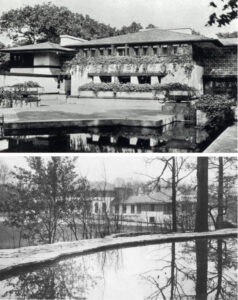
Top: The Avery Coonley Playhouse:
A Wright and Jensen Collaboration
Bottom: The Rock Pond at The Avery Coonley School
One such collaboration was with Frank Lloyd Wright on a home and garden design for industrialist Avery Coonley and his wife, Queene Ferry Coonley, on their ten-acre estate in Riverside in 1907.
As champions of early education, the Coonleys again hired the Wright and Jensen duo in 1912 to design a school on their estate. (The family had operated a “Cottage School” on their property since 1906). The new school, known as the Avery Coonley Playhouse, featured a workshop, stage and food preparation area.
When The Avery Coonley School relocated to its current location in 1929, Jensen was commissioned a third time to design the ten-plus-acre campus purchased by Mrs. Coonley, adjacent to the woods in Downers Grove. Both the architecture and grounds are of the Prairie style. Today, The Avery Coonley School’s outdoor space remains a living testament to the landscape artist’s vision.
His many notable clients included the Henry Ford automotive family, for whom he landscaped several properties. The dichotomous relationship between the industrialist and the naturalist lasted decades. Jensen also designed the estate of Sears and Roebuck magnate, Julius Rosenwald, which overlooked Lake Michigan in Highland Park

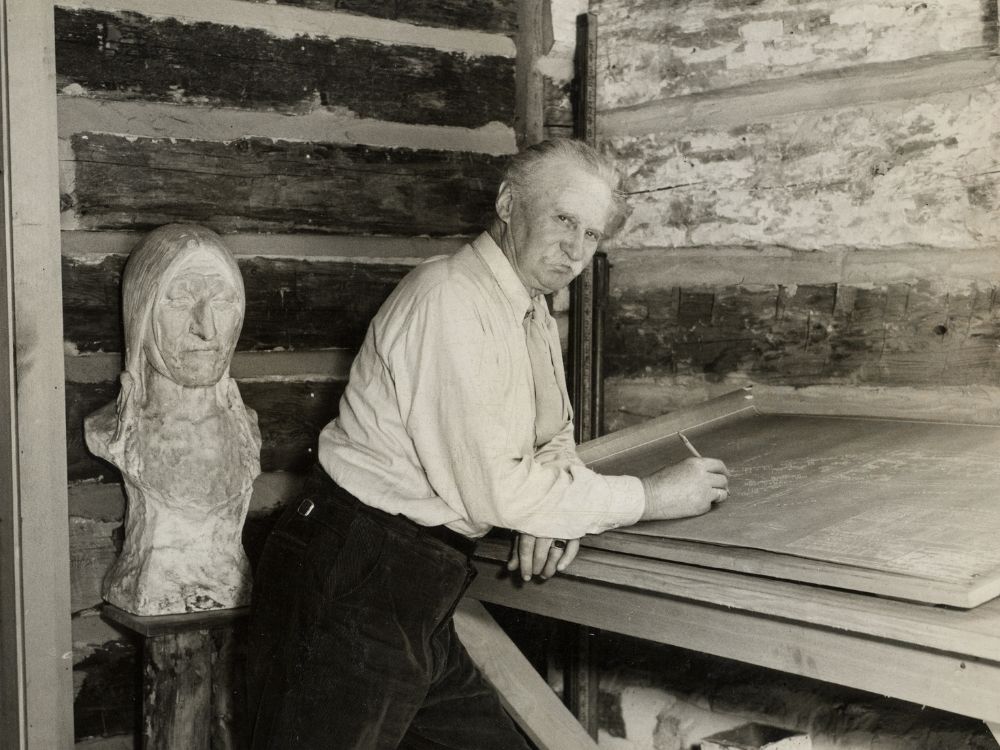
Jensen at his Door County folk school
After the death of his wife in 1935, Jensen built a family retreat in Ellison Bay, WI. He opened a folk school on the grounds named The Clearing, which overlooks Lake Michigan. Jensen spent the last years of his life building the school, teaching students and tirelessly crusading for conservation – a movement of which many consider Jensen to be the father. Still open today, students take up creative pursuits at The Clearing over weeklong sessions while staying on the beautifully windswept Door Peninsula.
When he died in 1951, The New York Times remembered Jens Jensen as the Dean of American Landscape Architecture. The man who had created over 600 masterpieces simply believed, “the beauty of nature is in our own backyards. It is everywhere.”