

More than a century later, Sears homes are still hiding in plain sight
By Maureen Callahan
If you live in the western suburbs, chances are that you’ve seen a Sears house. They’re in many Midwestern communities. Often, we drive right by these historical gems without ever seeing them. They blend right in on any suburban block until you know what they look like.
Sears houses are unique. They were built from kits. Initially, the owner picked up a pile of materials from a nearby railroad station and built the house – board by board and nail by nail. Sears home kits were not for those afraid to swing a hammer (however, the option to hire one of the company’s builders to assemble it for you was available). Eventually, through a collaborative effort of one’s family and friends, you had a well-built home.
The Sears home kits were sold from 1908-1940. Many of these houses still survive today. They’re full of charm and interesting architectural details. Local Sears home expert and curator of Sears-Homes.com, Lara Solonickne, advised us on a few questions relevant to these iconic residential properties.
Hinsdale Magazine Group (HMG): Can you give us an idea of some of the topics you cover on your blog?
Lara Solonickne (LS): I feature a different kit house in the Chicago area every month. I try to include information on the original owners if I can. If you closely examine the history of local Sears homes and their owners, sometimes you can also learn more about the history of Chicago, its suburbs, and life in the era before WWII. The articles on my website can go off on many tangents, which is great if you’re a history buff like me.
HMG: How did you decide to start this website?
LS: 13 years ago, my daughter, who was in third grade at the time, was assigned a project for the Chicago Metro History Fair on Sears houses. It was surprisingly difficult to gather information on their whereabouts. I decided to start a website devoted to Sears homes in the Chicago area so we can better preserve and protect them.
HMG: Could you describe a few qualities you find to be unique in Sears homes?
LS: One of the unique features of Sears houses is their timeless charm. Another reason for their appeal, even today, is their varied designs by notable architects such as John Van Bergen, White & Christie, and Henry Lawrence Wilson, to name a few. The houses also had so many interesting features, such as built-in ironing boards, medicine cabinets, and telephone niches. Outside, rounded doors, decorative roof brackets, and columns added exterior interest.
HMG: What do you find to be most interesting about them?
LS: One of the most interesting aspects is the wide range of architectural styles. Sears offered close to 400 different home designs, including Craftsman, Colonial Revival, Cape Cod, and Tudor styles. The wide variety of styles could accommodate almost any taste.
HMG: Which is your favorite model and why?
LS: I’m partial to an English cottage, so I like the Strathmore.
HMG: Which model is most prevalent, and do you know why?
LS: Today, the most prevalent model is the Sears Vallonia. However, it’s important to note that the models we see most often today may not accurately reflect how many were actually sold. Many Sears homes have been lost over the years. The chief architect for Sears indicated that the biggest seller was the Sears Argyle, although not many are standing today.
HMG: How do you think Sears Homes compared to other kit homes?
LS: Sears and their competitors, such as Montgomery Ward and Aladdin, all offered high-quality homes for a reduced price. The advantage Sears had over competitors at that moment was trust and name recognition as it was the world’s largest retailer.
HMG: Is there anything in particular you can think of that you would like area readers to know about Sears homes?
LS: I always say that Sears houses are hidden in plain sight. They can be found in the city and in almost every suburb. You drive by these charming houses all the time but never really see them. Finding these houses is like a scavenger hunt, and it teaches you to pay closer attention to the residential architecture all around you.
To learn more about Sears homes, visit Sears-Homes.com

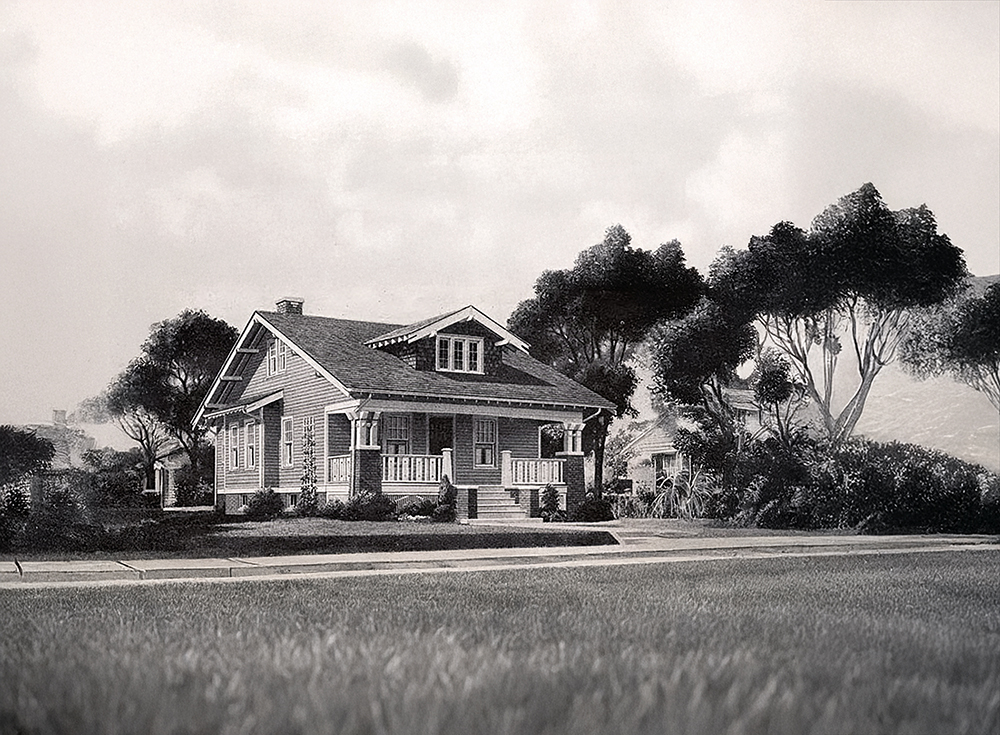
The biggest seller was the Argyle model, featured here in the catalog from the 1920s, although not many are standing today.

A photo of a Vallonia model today that has many of the original features intact, including railings, the porch, and columns.

The Strathmore model resembles
an English cottage.