
The Elmhurst Great Western Prairie
A living link with a new name
By Anna Hughes
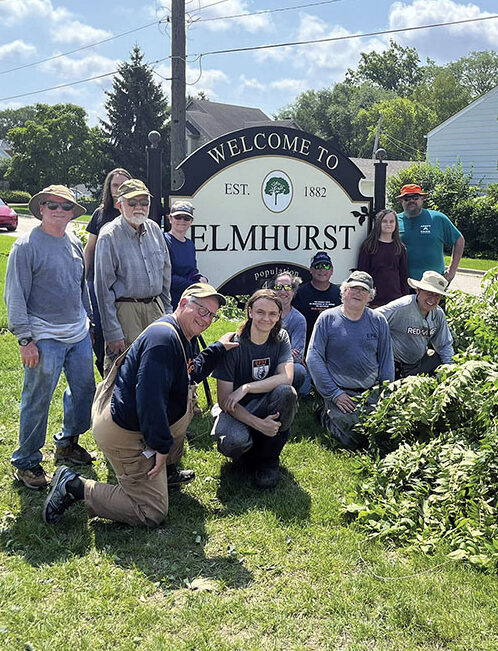
Volunteers meet at the prairie on the third Saturday of every month. The next volunteer date is July 20 Photo Elmhurst Great Western Prairie Facebook.
Beyond Elmhurst’s popular downtown scene, esteemed schools, and friendly neighborhoods is a rich history.
Elmhurst is known for its commercial growth, attracting residents and businesses from the Chicagoland area to join the community. In the midst of all the changes the city has seen since its incorporation in 1882, one thing has remained the same: an untouched piece of prairie land in the heart of the city.
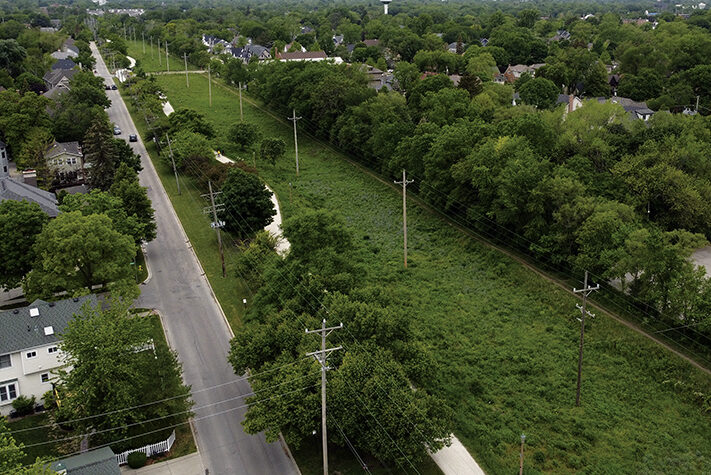
The Elmhurst Great Western Prairie – whose name was recently changed to the Keith A. Olson Prairie – is part of Wild Meadows Trace, which is located between Spring Road and Salt Creek, just north of the Illinois Prairie Path. This six-acre strip is estimated to be between 3,000-10,000 years old, making it the oldest living environment in Elmhurst.
“The Great Western prairie is a living link between some of the most ancient human history in our part of the country, and the present day,” Dave Oberg, the executive director of the Elmhurst History Museum, said. “It has stood the test of time, it has seen countless peoples and nations that have called this area home, and it is still here.”
“The Great Western Prairie is a living link between some of the most ancient human history in our part of the country, and the present day. It has stood the test of time, it has seen countless peoples and nations that have called this area home, and it is still here.”
– Dave Oberg, Elmhurst History Museum, Executive Director
Prairies are defined as stretches of flat grassland with moderate temperatures, moderate rainfall, and few trees (National Geographic). Although Illinois was once primarily prairies, now they only make up about 1% of the state. According to the Illinois Department of Natural Resources, Illinois had 22 million acres of prairie land and 14 million acres of forests in 1822.
By 1900, most of Illinois’ prairies were gone after being converted for agriculture. By 1978, less than 2,300 acres of high-quality prairie remained in the entire state.
“When you’re walking by the Great Western prairie … you are walking through history, you are seeing one of the last swathes of truly unspoiled prairie plantings that date back to the earliest periods of human history in this area,” Oberg said.
The Elmhurst Great Western Prairie has thrived for millenia mostly undisturbed thanks to a serendipitous series of events. According to the Elmhurst History Museum, the prairie was marked as a right-of-way for the Chicago Great Western railroad in the 1880s. In 1906, the Chicago Aurora and Elgin line was constructed parallel to the Great Western. This allowed for the prairie’s ecosystem to continue flourishing in between the two railroads.
When the CGW line was abandoned in 1957, local conservationists decided to turn the right-of-way for that railroad into a public trail path, known as the Illinois Prairie Path. By the late ‘70s, the Elmhurst Park District acquired the CGW line and developed it into a public park, now known as Wild Meadows Trace.
The EPD said that residents began working to clear the area of invasive plants and trees inhibiting the prairie growth. They also started controlled burns to help remove invasive shrubs and trees, removing dead stems and leaves without killing plant roots.
These efforts continue today. The EPD works with dedicated volunteers to maintain the history and ecosystem within the prairie. Each month, volunteers can meet for a great workout and be a helping hand in the city’s history.
One volunteer, the late Keith Olson, was so instrumental in the prairie’s maintenance for nearly 50 years, which is why the EPD recently voted to rename the Elmhurst Great Western Prairie to The Keith A. Olson Prairie. His tireless dedication to this small piece of land is a testament to the big ways just one person can make a difference in the community and world.
Thank you to the Elmhurst History Museum and the Elmhurst Park District for their expertise and photos. For information on how to volunteer, visit epd.org. ■
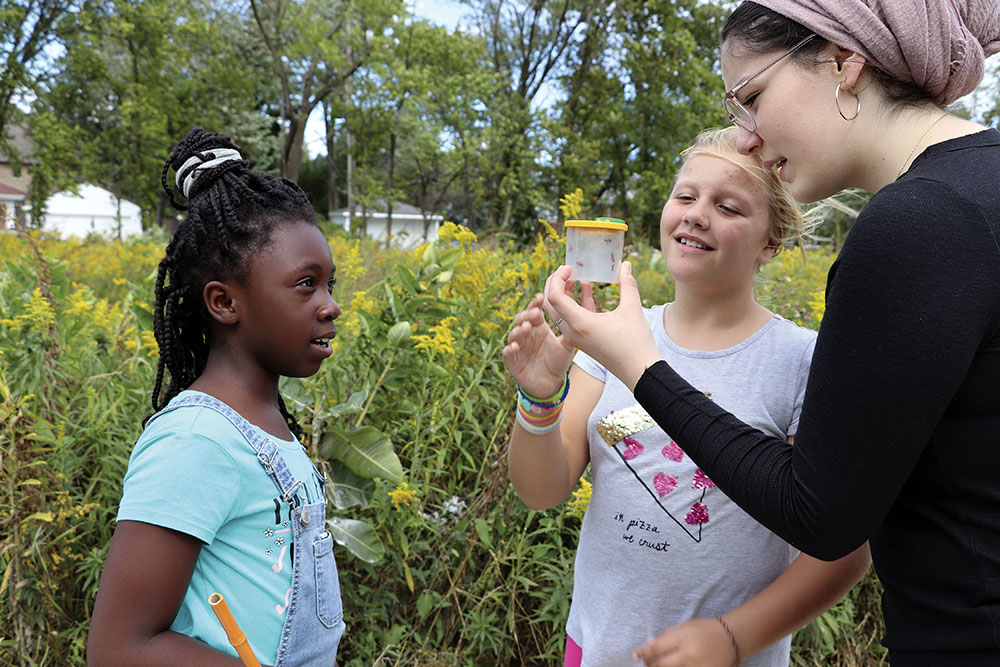
Students from Conrad Fischer Elementary enjoy a field trip to the prairie in 2019
Photo Elmhurst Park District.
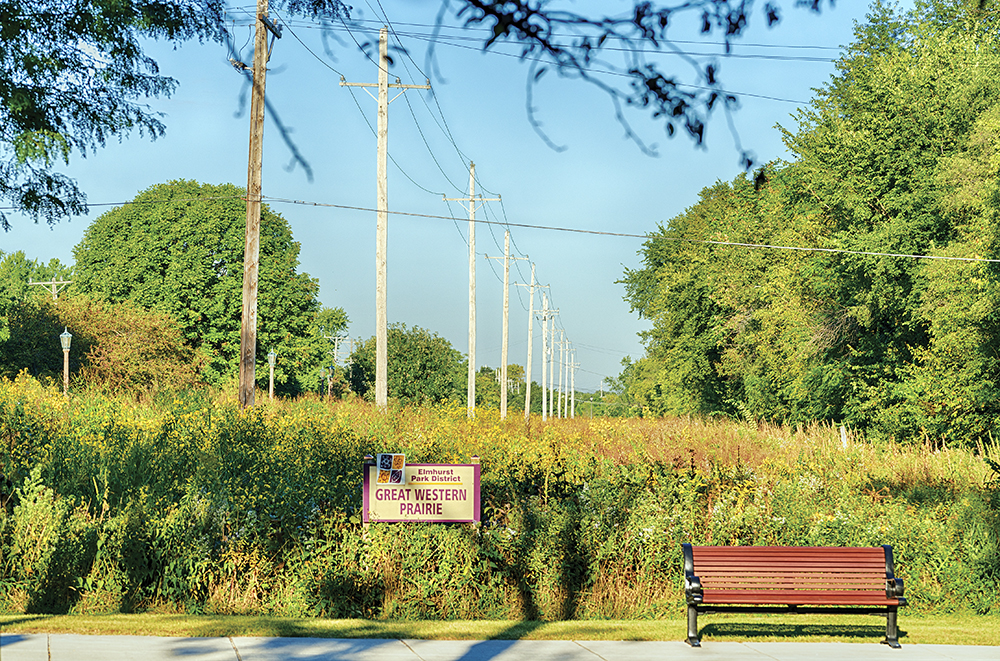
Elmhurst residents can identify the prairie thanks to Elmhurst Park District signs around the city Photo Elmhurst History Museum.