
Titanic – 40 Years After Discovery
A deeper dive into the mission that yielded one of the century’s great discoveries
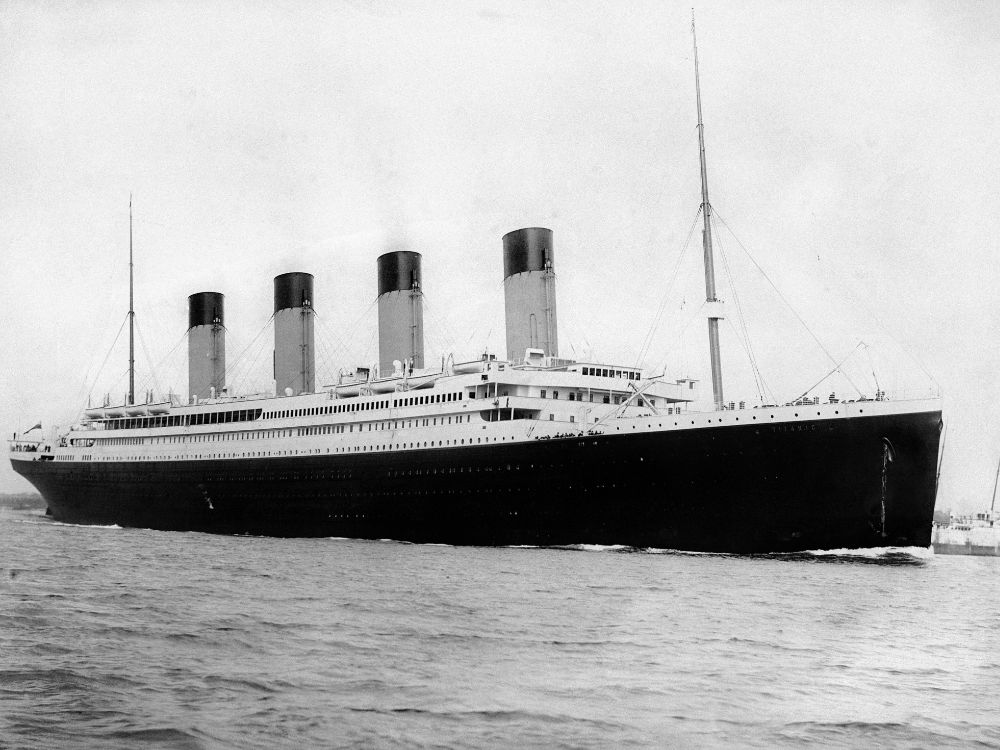
The location of the RMS Titanic – the largest and most opulent passenger steamship of its day – was one of the great mysteries of the twentieth century. The ship set sail from Southampton, England, on April 10, 1912, and was supposed to land in New York a week later. Four days into the voyage, however, the ship’s starboard side struck an iceberg in the middle of the night. Only 700 passengers of the 2500 onboard made it to the lifeboats. They were eventually rescued by the RMS Carpathia. The rest perished in the tragedy.
Although several expeditions tried to find the Titanic, she remained undisturbed at the bottom of the North Atlantic for more than seven decades.
There’s an old adage about luck favoring the one who is prepared. It’s likely Dr. Robert Ballard, oceanographer and retired Navy intelligence officer, concurs. In late August 1985, Ballard and his team of scientists set sail on a top-secret naval assignment to locate two missing nuclear submarines – the Scorpion and the Thresher.
It was a crucial moment in time. As the Cold War silently raged in the background, the US feared the Soviets would find the subs. To cover the mission’s real purpose, Ballard said he and his team were searching for the long-lost RMS Titanic, which was believed to have been nearby to the missing vessels.
The irony was, they found it.
Around 1.00 a.m. on September 1st, 1985, exactly the time of night Titanic had sunk 73 years earlier, Ballard and his crew began to see debris from the lost ship, starting with a boiler. The telltale piece designed specifically for the Titanic and its sister ships, Olympic and Britannic, provided the definitive clue.
The mission took its own place in history as one of the great discoveries of the twentieth century.
But it almost didn’t happen. Once the Scorpion and Thresher were accounted for, Ballard and his team were given permission by the Navy to look for Titanic, but little time remained before the scientists were due back in port. Serendipitously, the Titanic ended up being located in the middle of the two nuclear subs. The final resting place was determined to be 12,000 feet below the Atlantic’s surface, almost 400 miles off the coast of Newfoundland.
According to Ballard, the credit for finding the ship belongs to many, such as the oceanographer’s long-time friend and co-leader of the expedition, French scientist Jean-Louis Michel. Over the years, the French had organized their own missions in search of the Titanic. Michel invented the sonar system that photographed the ocean floor, which was crucial to viewing objects.
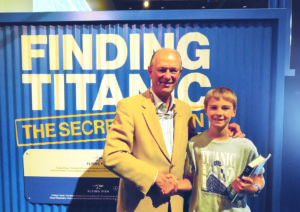
Dr. John Ballard, at the Peoria Riverfront Museum, encourages students to study hard and follow their dreams.
Interestingly, Ballard also believes that having dyslexia helped with solving the mystery of the missing ship. Looking at the expedition from all angles was crucial. He has described the hyper visual and spatial awareness afforded by dyslexia, which allowed his mind to create a 3D mental model of the underwater environment in which they were searching.
After Ballard returned home from the successful mission in the fall of 1985, his desk was covered in letters from kids all over the world. Many wanted to know how they could become scientists and make big discoveries. While Ballard always reminds kids to study hard, he decided to create a hands-on method of learning in the JASON Project, a non-profit interactive program. Students can be in real-world situations where they are guided by STEM professionals, where they can not only join Ballard on his expeditions but also be virtually transported to the Galapagos or Amazon rainforest.
For someone who has built such a storied – albeit largely underwater – career, Ballard was born in landlocked Wichita, Kansas, in 1943. His fascination with the ocean began when the family moved to San Diego, where he grew up in a home about 100 yards from the water.
Ballard’s graduation from the University of California, Santa Barbara distinguished him as the first in his family to graduate from college. He then earned a Master of Science in Geophysics from the University of Hawaii. Ballard served in both the Army and Navy before being assigned to the Woods Hole Oceanographic Research Institute on Cape Cod.
For this pioneer in deep-sea archeology, the Titanic isn’t the only feather in his cap. Ballard has logged more than 150 expeditions. His exploration flagship, Nautilus, predictably bears the moniker of the storybook submarine from Jules Verne’s 20,000 Leagues Under the Sea. Other career finds include the Nazi warship Bismarck, the British ocean liner Lusitania, the USS Yorktown aircraft carrier, and the PT–109 boat commanded by John F. Kennedy during World War II. There have been many other ships and artifacts in the Black Sea.
Now at 83 years young, Ballard continues to serve academia as a college professor at the University of Rhode Island. He has received many honors and awards for his discoveries, including the Lindbergh Award, the Explorers Medal, and the Hubbard Medal of the National Geographic Society.
His DEEP SEA – Deep Experimental Exploration Program in Science, Engineering, and Art is a program of activities to promote ocean awareness through a multisensory approach, especially for kids with dyslexia. Ballard looks to the future through his Ocean Exploration Trust, which will keep his work moving forward in his exploration of the deep corners of the ocean for years to come.
Finding Titanic: The Secret Mission is a traveling exhibition produced by Flying Fish in collaboration with Ocean Exploration Trust and generously sponsored by the Office of Naval Research and the National Oceanic and Atmospheric Administration. It is currently open at the Peoria Riverfront Museum through January 24, 2026. Visit peoriariverfrontmuseum.org for more information.