
Mahjong Madness
A captivating game, equal parts strategy and social, is sweeping its way through the suburbs
BY VALERIE HARDY
Step back, bridge, and bunco. There’s a new game in town—mahjong—and it’s spreading like wildfire across the western suburbs and throughout the nation.
The History of the Game
Many Americans only recently learned mahjong, but the game has a deeply rooted history. It originated in China during the nineteenth century, a gambling game played primarily by men. Mahjong made its way to the United States in the early twentieth century, proliferating around the 1920s, with many Chinese Americans, military wives, and Jewish women playing under varying rules. However, in 1937, a group of Jewish women in New York City formed the National Mah Jongg League (NMJL), standardizing the game; what is now known as American mahjong was officially born.
A Crash Course on Mahjong

Mahjong instructors Angela Buikema and Colleen Loftus at the mahjong league they
jointly run.
American mahjong is typically a four-player game using 144 tiles across three major suits – Bams (bamboos), Cracks (characters), and Dots (circles) – and four categories of non-suited tiles: Dragons, Flowers, Winds, and Jokers. Players try to create a winning hand (called a “mahjong”), based on one of many possible tile combinations as outlined on the annual card published by the NMJL. The most recent card features 71 distinct 14-tile “mahjong” sequences. A new card comes out each spring, so players are continually challenged to learn new tile combinations to “mahj” (win). Some compare mahjong to the more familiar tile-based game Rummikub or card games like canasta or gin rummy.
“Mahjong has exploded across cultures, genders, generations, and geographies.”
—Colleen Loftus of Mariposa Mahjong
Mahjong’s Ascent in Popularity
While mahjong has been played in the United States for nearly a century, its popularity peaked only recently. The game has become so popular that shoppers can find mahjong-themed merchandise in almost any local boutique, and many mahjong set distributors, like Oh My Mahjong, are frequently out of stock because the demand is so high.
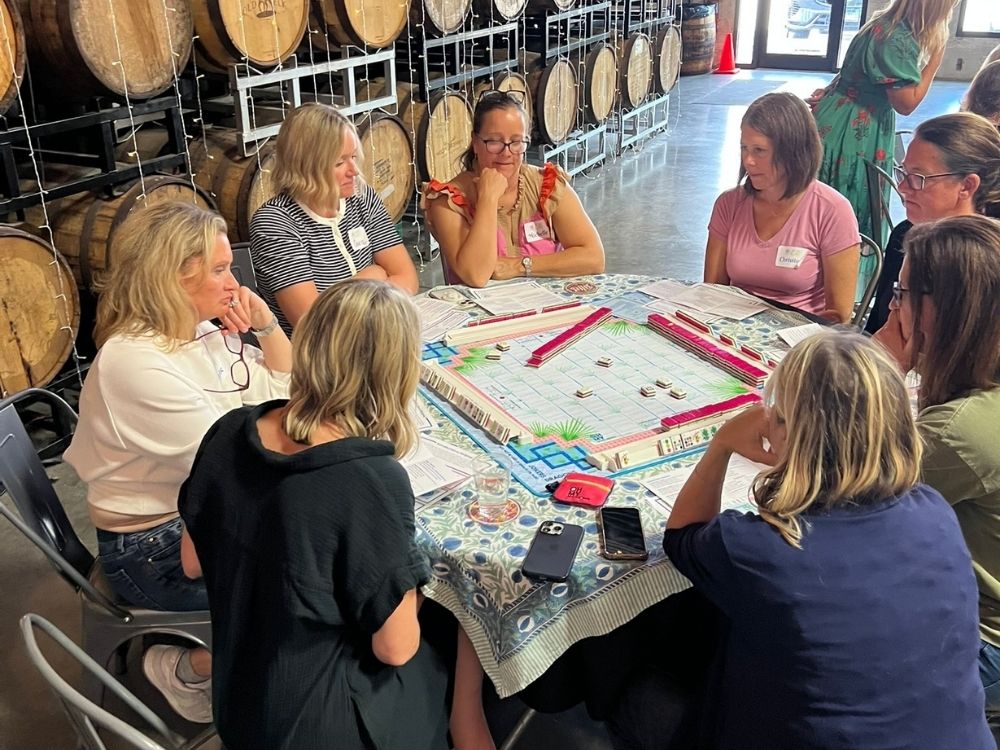
Interest in learning to play mahjong has also spiked, turning some mahjong players into professionals in response. Over the past year, Colleen Loftus (Mariposa Mahjong), Emily Hannigan (MahjEd), and Angela Buikema (Mahjong Mischief) all began local mahjong instruction businesses. Each runs multiple classes per week, often needing additional instructional assistants to accommodate the volume of participants.
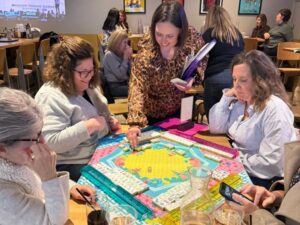
Angela Buikema teaches mahjong
at a public class in Elmhurst.
These mahjong instructors offer public classes at venues like local coffee shops, breweries, and libraries plus private classes at homes or country clubs. They teach introductory mahjong classes, and after taking an initial class, participants often sign up for at least one guided play session to gain a more nuanced understanding of the game. Loftus and Buikema recently partnered to provide tournament-style play for more experienced players through their Lucky Tiles Mahjong League, which began in January at Alter Brewing+ Kitchen in Oak Brook. Loftus, Hannigan, and Buikema also continue to grow their mahjong expertise, including through attendance at a national mahjong convention last month.
While not the same as in-person instruction, Buikema said those new to mahjong may find online tutorials and games or “periodically practicing making hands with a [tangible] tile set” helpful in becoming more comfortable with the game.
A Trend That’s Likely Here to Stay
Loftus explained that “mahjong has exploded across cultures, genders, generations, and geographies” for several reasons. It challenges players to use their brains, allows them to connect with old friends and make new ones, and has an appealing aesthetic. She noted that people are “drawn to the artistry of the tiles,” and the sensory experience extends beyond the visual. “Some people like the sounds of it too,” Hannigan said. “It’s like playing with blocks, or ASMR noise.”

Outdoor mahjong
for the win!
Hannigan said another appeal of mahjong is that each game is relatively short, typically 25-30 minutes. Mahjong can also be played any season and anywhere – even in the pool or hot tub, with floating boards and waterproof tiles now on the market.
Mahjong’s rituals are as important as its rules. Mahjong sometimes seems to have its own language. For example, the “dealer” is referred to as “East.” Players pass tiles to one another in a set order through a process known as “the Charleston.”
Yet the old game continues to have new applications. For example, in cities across the nation, “mahjong cafes are popping up,” Hannigan said. “Maybe I should open a local one!”
For now, people looking to learn mahjong can seek classes like those offered by Loftus, Hannigan, and Buikema or by contacting their public library or park district to see if mahjong programming is available.