
Somersaulting into Film Making
A trio of Downers Grove residents found success making children’s films
By Maureen Callahan
Finding one’s reason-to-be is often a lifelong search. Michael and Lillian Moats and JP Somersaulter- the trio behind the Somersaulter-Moats Film Collection- were lucky to find theirs early on.
From 1973 – 1991, the Downers Grove residents created predominantly short, animated films, mostly adapted and original fairytales for children. There were also a few stories geared toward older audiences with storylines influenced by myth, creativity, and the logic of thought.
Collectively, their films have received more than 40 awards at national and international festivals.
The story of how the trio found each other is an interesting one. Lillian and JP met as undergraduates at the University of Michigan, while studying creative writing. The two married a year later.
The following summer, JP, who had always been interested in filmmaking, talked Lillian into collaborating with him to create a series of industrial films for his father’s box-cutting supply business. His father agreed to buy the camera for his son in exchange for the work.
Little did they know it was a first step.
“Lillian and I went to a local camera store to get the supplies we needed for filming,” JP laughed as he recalled, “and the people working there laughed at us when they asked where our crew was, and we told them ‘we’re the crew.’” The two laughed last, however, as their five industrial films, created in one summer, are still in use, despite the box-cutting supply company having been sold more than once. “The funny part is that employees still have to sit through them,” Lillian relayed, as she chuckled.
Lillian and JP returned to the University of Wisconsin-Madison in 1969 to pursue Master of Teaching degrees. Their joint thesis project was another collaborative effort- this one an educational film for teachers entitled Three Magical Methods, with a guidebook for helping children learn to brainstorm for creativity. A trip to the Midwest Film Conference with their project encouraged them to continue film making, through children’s animated movies.
At that point, Lillian and JP were both teaching in Downers Grove, at Belle Aire and El Sierra schools. As a side gig, JP created a live show about how animation works, broken down by age level, from kindergarten through high school. “I would get students from the audience to volunteer and animate them like puppets,” said JP. “It was lucrative, and wacky fun for me.”
He began working with Young Audiences, a national organization for school performers. He performed in about 25 states with an audience of almost a million students.
“I lugged a suitcase of artwork and a 16-millimeter projector all over the country,” JP fondly recalled. “I still have the sweatshirt they gave me at Kitty Hawk elementary school.”

The Silverfish King (left) launched their career. Avery Coonley Schoolhorse (right) was animated by David Moats at age 9. Images courtesy of The Chicago Film Archives
Their first independent film, The Silverfish King, premiered at the Chicago International Film Festival. After it won a Certificate of Merit there, it went on to the World Animation Film Festival in Zagreb, Croatia.
They were contracted to create six more original animated films over the next several years, before divorcing. Able to remain the best of friends and business partners, however, they continued working together. Their art films led to a contract with Coronet Films-the country’s largest producer of children’s educational movies at the time.
As luck had it, when they went in to record the soundtrack to their next film, The Gingerbread Man, in 1978, Lillian met Michael Moats, the substitute sound engineer working that day. They were married a year later, with JP acting as the best man. The three continued working on films at Lillian and Michael’s 1100 Maple Avenue home.
Each film took almost a year to complete. The cottage on the property behind their home (the original house on the lot), served as the animation studio. JP periodically took the finished, or shot, 16-millimeter film to a laboratory in the city to be processed. A few days later, a “work print” would come back to the cottage to be edited.
Post-production, the work print went into the studio, and the soundtrack got put together against the finished film. All the drawings had to be timed exactly to the narration.
Michael, a full-time sound engineer at the time, expertly inserted mostly original music and sound effects. A storyboard of sorts was created through timing sheets on graph paper and Post-it notes with sketches of the scenes.
Lillian and Michael welcomed their son, David, in the early 80s. He created his own three-minute, 300 drawing, animated movie, Avery Coonley Schoolhorse, starring the school’s seahorse mascot, while he was a student at Avery Coonley.
As the computer era dawned, a self-taught Michael digitized the entire Somersaulter-Moats library of films. He also re-engineered JP’s long film and pet project, Donna Rosebud. The 80-minute movie takes place in a world where people speak only through mental telepathy. The artsy film featured every friend in JP’s life.
“It was guerrilla-filmmaking,” he said, as he laughed. “We climbed up the Goldblatt and Water Tower buildings without permission, to shoot footage. Those were the days when you could pretty much do whatever.”
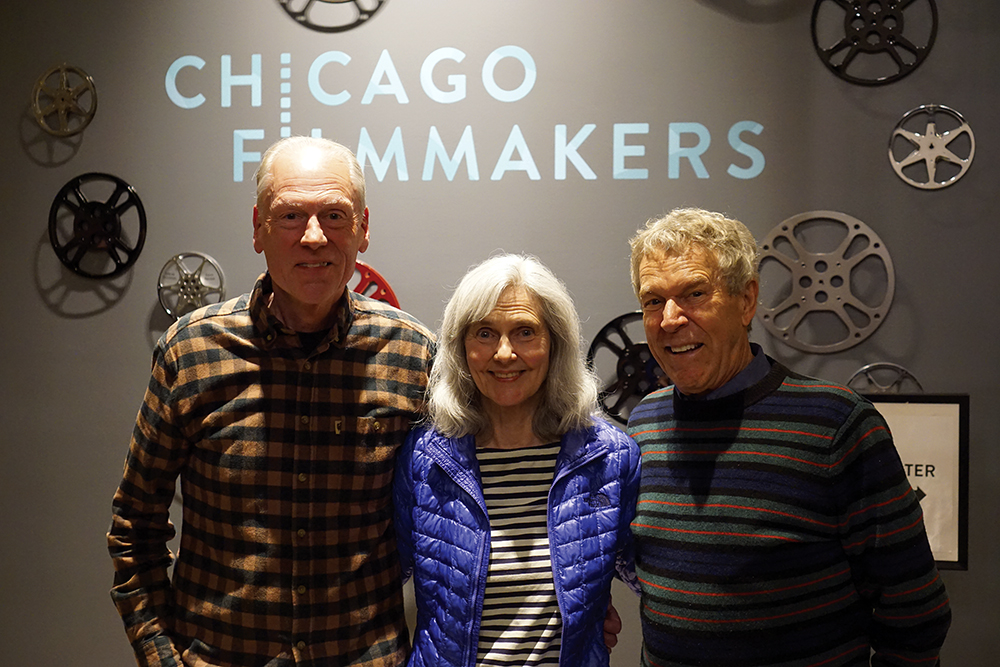
Donna Rosebud, finished in 1986, premiered at the Music Box Theater and the Art Institute. It was also featured in the Edinburgh Film Festival. Now completely digitally remastered by Michael, the trio held a screening in May of the film’s improved, finished production at Chicago Filmmakers in the city’s Edgewater neighborhood.
The three reunited, as JP had moved abroad some years ago. He flew in for the event from his current home, Ebora, Portugal. Michael and Lillian had just sold their Maple Avenue home and were on their way to retire to the United Kingdom to be closer to their son, who lives there.
The three had a chance to reminisce and enjoy a final screening of the new and improved Donna Rosebud. Also present were several cast and crew members and old friends. It was a bittersweet way to start life’s next chapter.
To check out the Somersaulter-Moats collection, visit the Chicago Film Archives at chicagofilmarchives.org.

Michael Moats, Lillian Moats and JP Somersaulter,
circa 1980, in the Moats’ Maple Avenue home
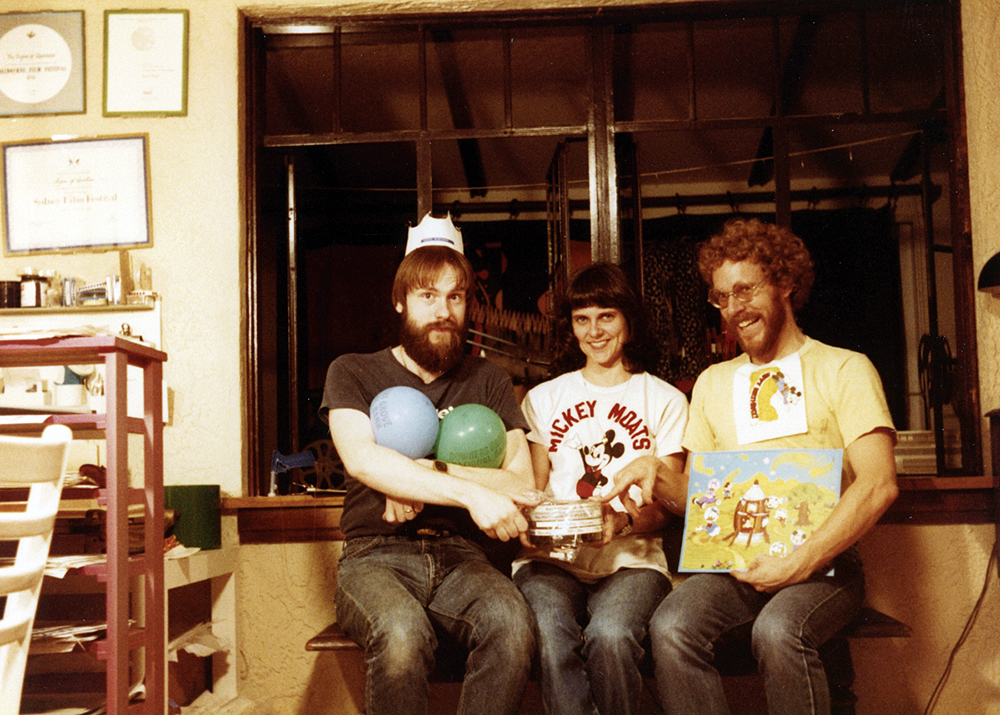
Michael Moats, Lillian Moats and JP Somersaulter,
circa 1980, in the Moats’ Maple Avenue home